
Family Relocation
Moving Abroad With Kids: An Age-by-Age Guide to Relocation
A practical, age-by-age guide to helping children adjust when your family moves abroad, including school transitions, language learning, friendships, grief, and family routines.

Moving abroad with kids is not automatically harmful or easy
Moving abroad as a family can give children new languages, friendships, cultural awareness, and a broader view of the world. But it can also involve grief, disrupted routines, school changes, language fatigue, and the loss of familiar social networks.
The most accurate answer is not that international relocation is either “good” or “bad” for children. Its impact depends on several factors, including:
- The child’s age and developmental stage.
- The number and frequency of previous moves.
- Family stability and parental stress.
- School continuity and academic support.
- The child’s ability to maintain important relationships.
- How much control and preparation the child receives.
For families planning a move from the USA to the UK, Germany, Spain, France, Italy, or elsewhere, the practical question is not simply, “Will my child adapt?” It is:
“What does my child need most at this stage of development—and how can we preserve stability while building a new life?”
The hidden grief of an international move
Children may grieve more than a house or a neighbourhood. They may be leaving:
- Best friends and classmates.
- Sports teams and extracurricular activities.
- Grandparents, relatives, babysitters, or trusted caregivers.
- A familiar school system.
- Their social status and sense of belonging.
- A version of themselves that existed in the old environment.
This is sometimes described as ambiguous loss: a form of grief in which what has been lost is still alive but no longer immediately accessible. A friend may still be available by video call, but the everyday relationship has changed. A favourite park may still exist, but the child can no longer visit it after school.
This can make relocation grief difficult to recognise. Children may not say, “I am experiencing loss.” Instead, they may become irritable, withdrawn, anxious, physically unwell, or resistant to school.
A positive attitude can help, but it should not replace emotional honesty. Children can be excited about their new home and deeply upset about leaving their old one at the same time.
How age changes the experience
Ages 0–2: Security comes from caregivers
Infants and toddlers do not understand international borders or relocation plans. Their sense of safety comes primarily from familiar caregivers, sensory experiences, and predictable routines.
The biggest risks at this age are usually:
- Disrupted sleep and feeding routines.
- Separation from familiar caregivers.
- Changes in daily sensory surroundings.
- Parental stress or emotional unavailability.
A young child may not remember the country they lived in, but they can still respond to changes in the adults and routines around them.
What helps:
- Keep sleep, feeding, and comfort routines as consistent as possible.
- Bring familiar blankets, toys, books, and other sensory objects.
- Arrange continuity with important caregivers where practical.
- Make parental rest and emotional regulation a priority.
- Avoid changing every routine at once after arrival.
For a baby or toddler, a calm and responsive caregiver is often more important than whether the new home is fully unpacked.
Ages 3–5: Make the move concrete
Preschool children tend to understand the world through routines, objects, and immediate experiences. Concepts such as “in three months” or “on another continent” may be difficult to grasp.
They may respond to relocation with:
- Sleep disruption.
- Separation anxiety.
- Toilet-training regression.
- Tantrums or aggression.
- Increased clinginess.
- Frustration when they cannot communicate in the new language.
What helps:
- Use simple, concrete language to explain what will happen.
- Create a picture book about packing, traveling, and arriving.
- Let the child choose a few toys or belongings to pack.
- Keep familiar family rituals, such as bedtime stories or weekend breakfasts.
- Introduce the new language gradually through play, songs, and everyday activities.
At this age, children generally benefit from knowing what will happen next more than from receiving a detailed explanation of the entire relocation process.
Ages 6–9: School and belonging become central
Children in early primary school begin developing important identities outside the family. Their school, friendships, teachers, clubs, and activities become significant sources of security and belonging.
A move may create difficulties with:
- Making friends in an established class.
- Understanding new classroom rules.
- Adjusting to a different curriculum.
- Managing language barriers.
- Comparing themselves with classmates.
- Expressing anxiety they do not yet have words for.
Stress may appear as headaches, stomachaches, sleep problems, irritability, or reluctance to attend school.
What helps:
- Speak with the school before the child starts.
- Ask how the school supports newly arrived international students.
- Arrange structured playdates rather than relying only on spontaneous social interaction.
- Continue familiar sports, music, art, or other activities.
- Choose activities where language is not the only route to participation.
- Ask specific questions about friendships and the school day.
Changing countries may be less disruptive than changing the child’s entire school environment. For school-aged children, the quality of the school transition deserves as much attention as the destination itself.
Ages 10–12: Agency and social status matter
Pre-adolescents are increasingly concerned with peer acceptance, social rules, and belonging. Leaving may mean losing years of accumulated social knowledge and status.
They may feel:
- Angry about a decision they did not make.
- Embarrassed about being new.
- Worried about fitting into an established peer group.
- Frustrated by unfamiliar slang or social expectations.
- Reluctant to discuss problems with parents.
At this stage, the child may understand the move perfectly well but still feel powerless.
What helps:
- Give meaningful choices about school, room design, activities, or goodbye plans.
- Let the child help research neighbourhoods and schools.
- Maintain regular contact with close friends at home.
- Set up local activities with repeated contact rather than one-off events.
- Validate anger without treating it as disrespect.
- Ask what would make the first month feel more manageable.
Agency does not mean allowing the child to decide whether the family moves. It means giving them genuine influence over parts of the transition.
Ages 13–15: Identity and friendships are especially important
Early and mid-adolescence can be one of the most difficult periods for an international move. Teenagers are working toward greater independence from their parents while relying heavily on peer relationships to develop identity and confidence.
A forced relocation can feel like:
- The loss of a carefully built social identity.
- A sudden return to dependence on parents.
- The destruction of friendships and romantic relationships.
- The loss of privacy and independence.
- A disruption to academic plans.
- A future they did not choose.
Resistance at this age is not necessarily immaturity or ingratitude. It may be a legitimate grief response to losing social belonging and autonomy.
What helps:
- Listen before trying to solve the problem.
- Avoid describing the move as an “amazing opportunity” every time the teenager expresses sadness.
- Agree on realistic ways to maintain important friendships.
- Support local integration without abruptly cutting off old relationships.
- Give the teenager privacy and age-appropriate independence.
- Discuss transport, social activities, technology, and curfews in advance.
- Consider counseling if distress is severe or persistent.
A teenager may need more collaboration and less instruction than a younger child.
Ages 16–18: Protect academic continuity and independence
For older teenagers, the move may affect exams, university applications, qualifications, credits, and future plans. A transfer between education systems can be complicated—for example, moving from a US high school curriculum into British A-Levels or a local European examination pathway.
Before choosing a school, compare:
- Curriculum and graduation requirements.
- Credit transfer policies.
- Examination dates.
- University entry requirements.
- Language requirements.
- Availability of advanced classes.
- Whether the school offers the International Baccalaureate or another internationally transferable pathway.
- The support available for students arriving mid-program.
Older teenagers may also resent losing driving privileges, part-time work, familiar transport, and established independence.
What helps:
- Involve the teenager in school research and decision-making.
- Obtain written academic guidance before moving.
- Treat the teenager as a partner in relocation planning.
- Create a realistic plan for social independence in the new country.
- Discuss travel back to the home country where feasible.
- Be transparent about financial, academic, and legal constraints.
For a teenager close to graduation, educational continuity may be more important than immediate cultural immersion.
The language trap: conversational fluency is not academic fluency
One of the most important issues for relocating families is the difference between conversational and academic language.
BICS: everyday social language
Basic Interpersonal Communicative Skills, or BICS, is the language used in familiar, context-supported situations such as:
- Talking with friends.
- Playing games.
- Ordering food.
- Asking simple questions.
- Participating in informal conversation.
Children may develop this type of communication relatively quickly, sometimes within six months to two years depending on age, exposure, support, and prior language experience.
CALP: academic and abstract language
Cognitive Academic Language Proficiency, or CALP, is needed to:
- Understand textbooks.
- Follow complex classroom explanations.
- Write essays.
- Analyze literature.
- Compare and evaluate ideas.
- Learn science, history, and mathematics through a second language.
Academic language is more abstract and less supported by gestures, pictures, or immediate context. Developing it can take at least five years, and in some circumstances five to seven years.
This creates a common problem: a child may sound fluent at home or on the playground while still struggling with reading, writing, tests, and subject-specific vocabulary.
Practical advice for parents:
- Do not assume conversational fluency means the child no longer needs language support.
- Ask teachers how academic comprehension is being assessed.
- Monitor reading, writing, and subject-specific performance.
- Continue tutoring or language support after everyday conversation improves.
- Ask whether the school distinguishes language acquisition from learning difficulties.
If academic performance declines after a child begins speaking comfortably, the issue may be academic language—not intelligence, effort, or motivation.
Third Culture Kids: opportunity and complexity
A Third Culture Kid, or TCK, is generally understood as someone who spends a significant part of childhood outside their parents’ culture.
Children raised across countries may develop:
- Cross-cultural awareness.
- Comfort with difference.
- Linguistic flexibility.
- Adaptability in unfamiliar settings.
- A broader understanding of social and cultural norms.
Research on residential mobility also suggests that people who move frequently may place greater emphasis on personal traits and abilities because those qualities travel with them, while local group memberships are repeatedly disrupted.
However, international mobility does not create a universal advantage. Some children experience:
- Difficulty answering “Where are you from?”
- A weak sense of geographic belonging.
- Reluctance to form close friendships.
- Grief after repeated goodbyes.
- Difficulty returning to the passport country.
- A feeling of being understood mainly by other internationally mobile people.
The goal should not be to create a “global child” at any cost. The goal is to help the child build a stable identity that can include more than one culture.
Choosing a school after moving abroad
There is no universally best school model. The right choice depends on the child’s age, language ability, length of stay, academic pathway, and long-term plans.
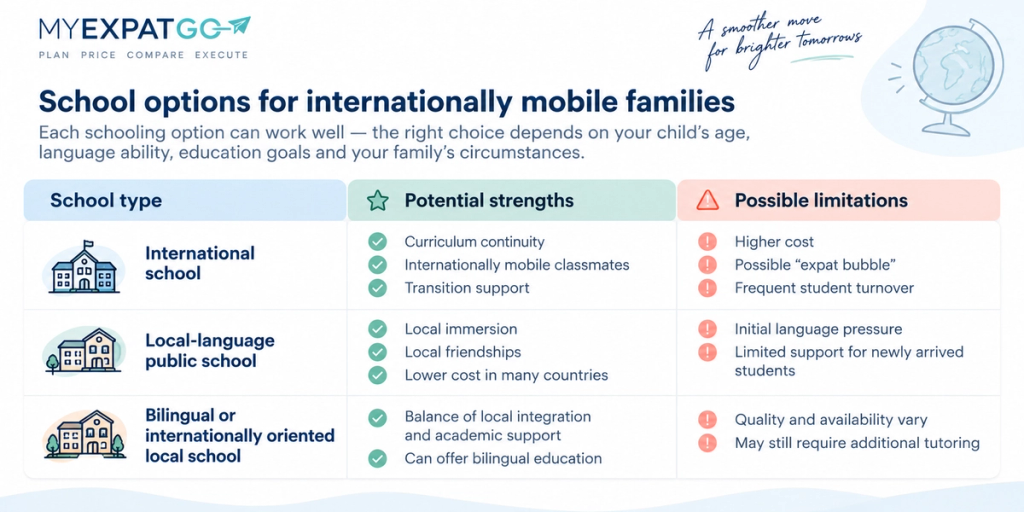
For younger children, local-language immersion may be manageable when the school provides strong support. For older children, particularly those approaching major exams, curriculum continuity may deserve greater weight.
Before enrolling, ask:
- What happens when a student arrives with limited local-language ability?
- Is there dedicated language support?
- How are academic gaps identified?
- Can previous credits transfer?
- What qualifications does the school offer?
- How does the school support friendships and pastoral care?
- What are the likely class sizes and student turnover?
- Can the child visit or speak with current students?
A practical relocation roadmap
Before the move
- Explain the move honestly using age-appropriate language.
- Give children real choices where possible.
- Plan meaningful goodbyes rather than rushing the departure.
- Create a list of important people, places, and routines to preserve.
- Research schools and academic pathways early.
- Identify language support before arrival.
- Discuss what will change and what will remain the same.
During the first month
- Re-establish regular sleep and meal schedules.
- Unpack familiar comfort items early.
- Preserve family rituals.
- Keep expectations modest.
- Maintain contact with close friends and relatives.
- Avoid scheduling every hour with activities.
- Pay attention to parental stress and conflict.
During the first three months
- Introduce local activities gradually.
- Choose activities with repeated opportunities to meet the same children.
- Continue old friendships while building new ones.
- Ask open-ended questions about school.
- Expect some regression, irritability, or withdrawal.
- Recognize that adjustment is not always linear.
During the first school term
- Check academic performance, not just conversational ability.
- Ask teachers about reading, writing, and classroom comprehension.
- Confirm that language support has not been withdrawn too early.
- Monitor attendance, friendships, sleep, and physical complaints.
- Arrange extra support if academic or emotional difficulties persist.
During the first year
- Review whether the child is developing local connections.
- Watch for chronic school refusal or severe withdrawal.
- Continue family routines even after daily logistics improve.
- Talk about identity, belonging, and what “home” means.
- Seek professional support for persistent or serious concerns.
When to seek additional support
Some disruption is expected after an international move. However, professional support may be appropriate when a child experiences:
- Persistent social withdrawal.
- Ongoing school refusal.
- Severe or continuing sleep disruption.
- Significant academic disengagement.
- Persistent hopelessness.
- Self-harm or talk of suicide.
- Anxiety or depression that interferes with daily life.
- Symptoms that remain severe beyond the initial adjustment period.
If there is an immediate risk of self-harm or suicide, contact local emergency services or an urgent mental-health crisis service.
The most important protective factor
The strongest practical message for parents is that children often take emotional cues from the adults around them. A parent does not need to appear perfectly calm or pretend that the move is easy. But children benefit when parents acknowledge difficulty, regulate their own stress, and remain emotionally available.
A child can adapt to a smaller home, a new school, unfamiliar food, or a different language more successfully when the family provides:
- Predictable routines.
- Stable caregiving.
- Honest communication.
- Age-appropriate choice.
- Continued relationships.
- School support.
- Permission to grieve.
Moving abroad with children is not about eliminating every difficulty. It is about building enough stability around the difficulty for children to process change, form new connections, and develop a confident sense of who they are.
Helpful relocation resources from MYEXPATGO
Planning an international move involves more than booking transportation. Families may also need to coordinate:
- Household shipping and storage.
- School and education planning.
- Temporary housing after arrival.
- Customs documentation.
- Visa and residency timelines.
- Local healthcare and settling-in priorities.
- Moving quotes that accurately reflect the household and destination.
Use the Get Moving Quotes process to share your move details with relevant providers, or explore MYEXPATGO’s relocation planning support for education, timelines, documentation, temporary housing, and settling-in priorities.
This article provides general information and is not medical, psychological, legal, immigration, tax, or educational advice. Every child responds differently to relocation. Consult an appropriately qualified professional for concerns about a child’s mental health, safety, schooling, or development.
Get Moving Quotes
Get up to five free quotes from vetted international moving companies.