
Destinations
Moving to the UK in 2026: Visas, Costs and First Steps
Planning a move to the UK in 2026? Compare common visa routes, current immigration costs, regional rents, NHS access, tax basics and the essential tasks to complete after arrival.

Quick answer: Moving to the UK in 2026 involves choosing the right visa route, completing admin tasks in your first 30 days, understanding the NHS and private healthcare options, and budgeting for rent that averages £1,393 a month nationally but £2,317 in London. Costs, timelines, and rules vary by route and region, so confirm details with official sources before you commit to a date.
Relocating to the UK involves more moving parts than most people expect. You're not just packing boxes and booking flights. You're choosing an immigration route, registering with a bank, finding a GP, and figuring out whether your profession needs re-licensing before you can work. Each of these steps has its own timeline, cost, and paperwork, and they don't always happen in a convenient order.
This guide is built around what you'll actually face in the first year, starting with the visa decision that shapes everything else. You'll find practical numbers, not vague estimates: current salary thresholds, processing times, tax bands, and rental benchmarks drawn from UK government and official sources. Where a rule depends on which part of the UK you're moving to, that's flagged clearly, because England, Scotland, Wales, and Northern Ireland don't always run the same system.
By the end, you should have a realistic picture of what your move will cost, how long each stage takes, and what to check before you sign a lease or accept a job offer. Use it alongside official government resources, not instead of them. Immigration rules and fees shift from year to year, and this guide reflects the position as of August 2026.
Which UK Visa Route Fits Your Situation?
Your visa route determines almost everything else about your move: how long you wait, what you pay, and whether your family can join you. The UK uses a points-based immigration system, but in practice, most people fall into one of a handful of common routes.
Skilled Worker Visa
The Skilled Worker route suits employees with a confirmed job offer from a licensed UK sponsor. For 2026, the standard salary threshold is generally £41,700 per year or the occupation's "going rate," whichever is higher, according to GOV.UK. New applicants typically need English ability at B2 level. Processing usually takes around 3 weeks if you apply from outside the UK, or 8 weeks from inside. Application fees run from £819 to £1,618 depending on visa length, plus the Immigration Health Surcharge of £1,035 per person, per year.
Family Visa
If you're joining a spouse, partner, or qualifying relative already in the UK, the Family visa is the relevant route. The partner route generally requires a combined annual income of £29,000. Processing typically takes 12 weeks from outside the UK or 8 weeks in-country when requirements are met, and the standard qualifying period before settlement is 5 continuous years.
Student Visa
Student visa applicants need a Confirmation of Acceptance for Studies (CAS), proof of tuition funds, and maintenance funds of £1,529 per month in London or £1,171 per month outside London, for up to 9 months. Processing timelines mirror the Skilled Worker route: around 3 weeks outside the UK, 8 weeks inside.
Ancestry Visa
Commonwealth citizens with a UK-born grandparent may qualify for the Ancestry visa, which allows work in the UK without needing employer sponsorship. If this route applies to you, confirm current eligibility and documentation requirements directly with GOV.UK, since specific fees and conditions change periodically.
Points-Based System Overview
All of these routes sit within the UK's points-based immigration framework, which assesses applicants against criteria like job offer, salary, skill level, and English proficiency. The route you qualify for depends on your circumstances, not a single universal application. If you're unsure which route fits, a regulated immigration adviser registered with the Immigration Advice Authority (IAA) or a solicitor regulated by the SRA can confirm your options before you apply.
Your First 30 Days Checklist
The UK doesn't require a single mandatory address registration like some European countries. Instead, your first month is about building an administrative footprint, piece by piece.
Days 1–3
- Confirm your address and keep your tenancy agreement accessible.
- Activate a UK mobile number.
- Check that your employer has completed right-to-work verification.
- Start the process of opening a current account.
Days 4–7
- Register with a GP near your home.
- Set up any utilities not included in your rent.
- Begin council tax registration if you're responsible for it.
Days 8–14
- Complete bank onboarding if it's still pending.
- Confirm your tax code and National Insurance position with your employer.
- If you have children, contact your local council about school admissions immediately.
Days 15–30
- Review your first payslip carefully.
- Set up direct debits for energy, broadband, and council tax.
- Exchange or test your driving licence if your current one requires it.
- Keep every document together: passport, eVisa, tenancy, employment contract, and tax records.
Two deadlines matter more than the rest. If you're self-employed and new to UK tax, notify HMRC by 5 October following the relevant tax year. For the 2025/26 tax year, that's 5 October 2026. School applications in England close on 15 January for primary and 31 October for secondary places the following year, so apply early if you're relocating with children.
Understanding the NHS and Your Healthcare Options
Healthcare in the UK runs on a tax-funded public system, supplemented by private insurance for those who want faster access or more choice.
Most people on a temporary visa pay the Immigration Health Surcharge, currently £1,035 per person, per year, with a reduced rate of £776 for students and Youth Mobility applicants. Health and Care Worker visa holders are generally exempt. Paying the IHS grants NHS access, but it doesn't make every service free. Prescriptions, dental care, and optical services can still carry charges depending on where you live.
Your first action once you arrive should be registering with a local GP practice. The GP becomes your point of entry into the system and handles referrals to specialists. For urgent but non-emergency needs, NHS 111 is the number to call; for emergencies, it's 999.
Private healthcare isn't required if you have NHS access, but it can shorten waiting times. Expect to budget roughly £40–£120 a month for an individual plan, or £100–£300 or more per person for family cover, depending on age, location, and the level of benefits included. These are market estimates rather than fixed prices, so compare quotes from UK-authorised brokers before choosing a policy.
Banking and Tax Considerations
Opening a Bank Account
Newcomers commonly use HSBC UK, Barclays, Lloyds, NatWest, or Santander UK for their international experience and branch networks. Digital-first options like Monzo, Starling, Revolut, and Wise are also widely used, though Wise itself notes that its account details aren't necessarily equivalent to a traditional UK bank account. Expect to provide your passport, immigration status, UK address, and proof of address. Some banks may also ask about your employment or UK credit history.
Understanding Your Tax Position
The UK tax year runs from 6 April 2026 to 5 April 2027. For England, Wales, and Northern Ireland, income tax is charged at 20% on the first £37,700 of taxable income after your Personal Allowance, 40% up to £125,140, and 45% above that. Scotland uses a separate system, with rates from 19% to 48% depending on income band. The standard Personal Allowance is £12,570, tapering to zero once your income passes £125,140.
Self-Assessment and National Insurance
If you're self-employed, register with HMRC once your business income exceeds £1,000 in a tax year. The online Self Assessment deadline for 2025/26 is 31 January 2027, with a paper deadline of 31 October 2026. Employee National Insurance is charged at 8% on standard earnings and 2% above the upper earnings limit for 2026/27.
Choose a UK bank account that matches your needs: a mainstream high-street bank if you want in-person support while you settle in, or a digital account if you prioritize speed and app-based management. Either way, confirm which documents your chosen bank accepts before you arrive, since onboarding friction is common even with a valid visa.
Housing and Neighborhoods
What Rent Actually Costs
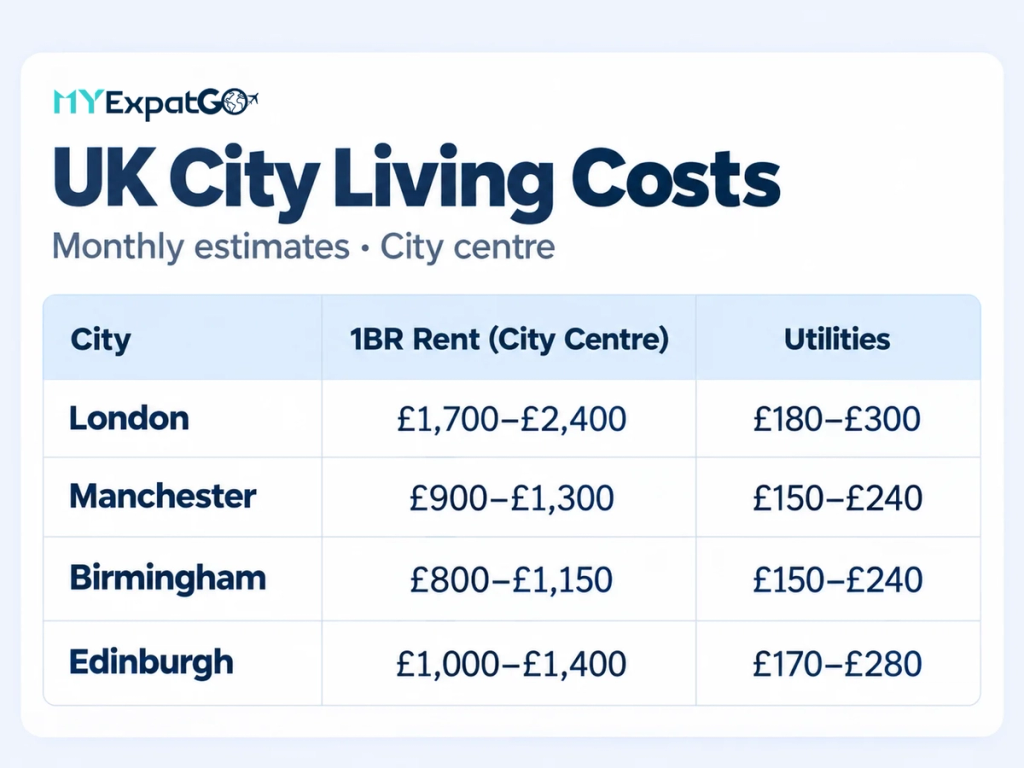
According to the Office for National Statistics, average UK private rent reached £1,393 a month in July 2026, while London averaged £2,317. Manchester averaged around £1,365 and Birmingham around £1,093 in the same period. These national averages hide significant variation between boroughs and towns, so treat them as a starting benchmark rather than a quote.
Popular Neighborhoods
In London, Richmond and Barnet suit families seeking green space, while Islington and Clapham attract professionals wanting easy access to the City and West End. In Manchester, Didsbury and Chorlton offer a community feel, while Ancoats suits those wanting a central, apartment-based lifestyle. In Birmingham, Edgbaston and Harborne are popular with families, while the Jewellery Quarter draws younger professionals. In Edinburgh, Stockbridge and Morningside suit families, while Leith offers better value with a growing creative scene.
Renting, Deposits, and 2026 Changes
In England, the maximum tenancy deposit is 5 weeks' rent for annual rents below £50,000, or 6 weeks' rent above that, and deposits must be protected in an approved scheme within 30 days. A major shift took effect on 1 May 2026: England replaced assured shorthold tenancies with assured periodic tenancies under the new Renters' Rights regime, changing eviction rules and rental practices. If you're renting in England, ask your letting agent how these reforms affect your specific tenancy before you sign.
Buying Property
Foreign nationals can buy property in the UK, though mortgage approval, deposit requirements, and legal processes vary by lender and visa status. If you're considering buying rather than renting initially, speak with a mortgage adviser experienced in non-resident or recent-arrival applications before committing, since lending criteria differ from standard resident mortgages.
Work and Business Opportunities
Technology, financial services, engineering, life sciences, healthcare, and education consistently show strong demand for international professionals. Indicative 2026 salary ranges include £40k–£90k for software engineers, £40k–£85k for data analysts, and £30k–£55k for registered nurses, though these are planning benchmarks rather than fixed figures.
If your profession is regulated, such as nursing, medicine, teaching, or law, a foreign degree alone won't qualify you to practice. Internationally trained nurses, for example, typically go through the Nursing and Midwifery Council's overseas registration process. Confirm your profession's specific recognition route with the relevant UK regulator before assuming your qualifications transfer directly.
If you're planning to start a business instead, you have two main structures: operating as a sole trader, which is simpler but carries unlimited personal liability, or forming a private limited company through Companies House, which offers limited liability but more administrative requirements. Digital incorporation currently costs £100. If your visa depends on employer sponsorship, confirm your sponsor's licence status and your role's eligibility before resigning from a previous position or relocating your family.
Education for Children and Adults
England provides free state schooling for eligible children, with admissions handled locally and differing slightly across Scotland, Wales, and Northern Ireland. Most children start Reception around age 4. If you're relocating with children, check your visa conditions to confirm the school attendance is permitted, and apply for places as early as possible given the admissions deadlines mentioned earlier.
Private and international schools are a significant cost consideration, particularly in London and surrounding areas. Published 2026/27 fees at schools like ACS Egham range from roughly £25,860 for Kindergarten to £37,440 for Grade 12, while the International School of London's fees span approximately £24,930 to £39,940 depending on age. If international schooling is part of your plan, build these costs into your relocation budget early, since they can rival or exceed housing costs in some areas.
For working parents, eligible families in England can access 30 funded childcare hours per week, for 38 weeks a year, for children aged 9 months to 4 years. Adults looking to continue professional development can access university courses, adult education centres, and British Council-accredited language schools, useful even for English speakers who want support with professional or academic writing.
Culture and Lifestyle
English is the primary language across the UK, and an English-only speaker can live comfortably in London, Manchester, Birmingham, and Edinburgh without needing another language for daily life. That said, some visa routes require formal English proficiency testing, so check your specific route's language requirement separately from your personal comfort with the language.
British workplace culture tends to favor punctuality, first-name use, and polite indirectness when disagreeing. Queuing is culturally significant, and phrases like "sorry," "please," and "thank you" appear constantly in everyday interaction. Tipping in restaurants is common but not usually mandatory, unlike some other countries.
Transportation varies by city. London offers an extensive Underground, bus, and rail network. Manchester combines trams, buses, and rail. Birmingham functions as a national rail hub with its own tram and bus system. Edinburgh is compact and highly walkable, with strong bus and rail connections. If you're bringing a car, check driving licence exchange rules for your country of origin before you assume your current licence will work indefinitely.
Trusted Services and Resources
Before relying on any relocation service, confirm it's appropriately regulated or officially recognized. For immigration advice, look for solicitors regulated by the SRA or advisers regulated by the IAA, and verify their status through the regulator's directory rather than taking online rankings at face value. For tax matters, particularly if you have foreign investments, pensions, or multi-country income, a Chartered Accountant or ACCA-qualified adviser with cross-border experience is worth the cost.
For the planning side of your move, a connected workspace can replace the scattered spreadsheets and browser tabs many people end up using. MYEXPATGO's My Move Pro, currently in development with planned pricing of €99 for 6 months of access, organizes your timeline, documents, budget, and inventory around your specific route and household rather than a generic checklist. If you want to compare moving quotes from multiple providers without rebuilding a spreadsheet for every quote, the Founding Planner package bundles Quote Intelligence with the Moving Inventory & Volume Planner for a one-time €79 payment, with founding-member status that doesn't expire even though product access runs for 12 months from activation. Both tools are planned for general availability in Q1 2027, so confirm current access terms before purchasing.
Beyond paid tools, community groups like InterNations chapters in London, Manchester, and Edinburgh, along with city-specific Facebook groups and forums such as r/expats, can help you find practical, peer-tested advice from people who've recently gone through the same process.
2026 Regulatory Updates You Should Know About
A few changes are worth flagging specifically because they affect timing and cost decisions:
- The Skilled Worker salary threshold stands at £41,700, with new applicants generally needing B2 English.
- The Graduate visa offers 2 years for applications made on or before 31 December 2026, dropping to 18 months from 1 January 2027, except for doctoral graduates who retain 3 years.
- Home Office visa fees were revised from 8 April 2026.
- England's Renters' Rights Act took effect on 1 May 2026, replacing assured shorthold tenancies with assured periodic tenancies.
- The National Living Wage rose to £12.71 per hour from 1 April 2026.
- Companies House incorporation fees increased to £100 for digital applications from 1 February 2026.
If you're planning a move for later in 2026 or into 2027, re-check these figures closer to your move date, since fees and thresholds are reviewed periodically.
Frequently Asked Questions
What documents do I need to bring?
At minimum, bring your passport, visa or eVisa confirmation, employment contract or CAS (if studying), proof of funds, and any professional qualification certificates you may need for licensing or job applications.
How long does visa processing take?
Most routes, including Skilled Worker and Student visas, process in around 3 weeks if applying from outside the UK and 8 weeks if applying in-country. Family visas typically take 12 weeks from outside the UK.
Can I work while waiting for visa approval?
This depends entirely on your specific visa route and current immigration status. Check your visa conditions directly with UKVI or a regulated immigration adviser before assuming you can work during processing.
What are the costs of relocation?
Costs vary widely by visa route, city, and household size, but expect to budget for visa fees (£819–£1,618 for Skilled Worker, for example), the Immigration Health Surcharge (£1,035 per year), moving and shipping costs, and several months of rent as a landing reserve.
How do I transfer my qualifications?
Academic recognition and professional licensing are separate processes. For regulated professions like nursing, teaching, or law, contact the relevant UK regulator directly rather than assuming your degree alone qualifies you to practice.
Settling In: What to Do Next
A UK relocation involves several parallel tracks: immigration, healthcare, housing, tax, and if you have children, education. None of these steps are especially complicated on their own, but they do need to happen in roughly the right order, and some have hard deadlines that are easy to miss if you're not tracking them.
Start with your visa route, since it determines your timeline for everything else. Build your first 30 days around GP registration, banking, and tax setup. Budget realistically for your chosen city rather than relying on national averages alone, and confirm regulated-profession requirements before assuming your qualifications transfer automatically.
Use official sources like GOV.UK, HMRC, and the NHS for anything time-sensitive or financially significant, and bring in a regulated adviser when a decision involves real money or your immigration status. A clear plan, checked against the right sources, will get you settled with far fewer surprises along the way.
Plan your move in one place
Plan your move in one place MYEXPATGO’s My Move Pro is being developed to organise relocation tasks, documents, budgets and inventory around a household’s actual move. Quote Intelligence and the Moving Inventory & Volume Planner are also planned tools for comparing mover proposals and estimating shipment volume. Check the product pages for current availability, scope and pricing before registering or purchasing.

