
Moving Tips
How Long Does an International Move Take? A Realistic USA-to-Europe Timeline
The ocean crossing is only one part of an international move. This realistic USA-to-Europe timeline explains when to start, what happens before and after shipping, and where delays most often occur.

A move from the USA to Europe can take six to twelve months to plan, even though your belongings may spend only a few weeks at sea. The real schedule includes choosing a country and immigration route, reducing and surveying your shipment, comparing quotes, preparing customs documents, packing, export handling, transport, customs clearance and final delivery.
For the physical shipment, broad industry planning ranges often run from approximately six to twelve weeks door to door for a dedicated container and eight to sixteen weeks for groupage or another shared-container service. Air freight is often planned in a range of roughly one to three weeks. These are planning ranges, not promises: the route, season, shipment size, consolidation schedule, documentation, customs activity and delivery location can all change the result.1
The most useful way to plan is therefore not to ask only, “How long is the sailing?” Ask instead: When must each decision be completed so that the move remains workable?
Important: Every timeframe in this guide is indicative. Your mover’s written schedule for your specific origin, destination, shipment size and service should take priority. Ask whether the quoted transit time is port to port, terminal to terminal or genuinely door to door.
The timeline at a glance
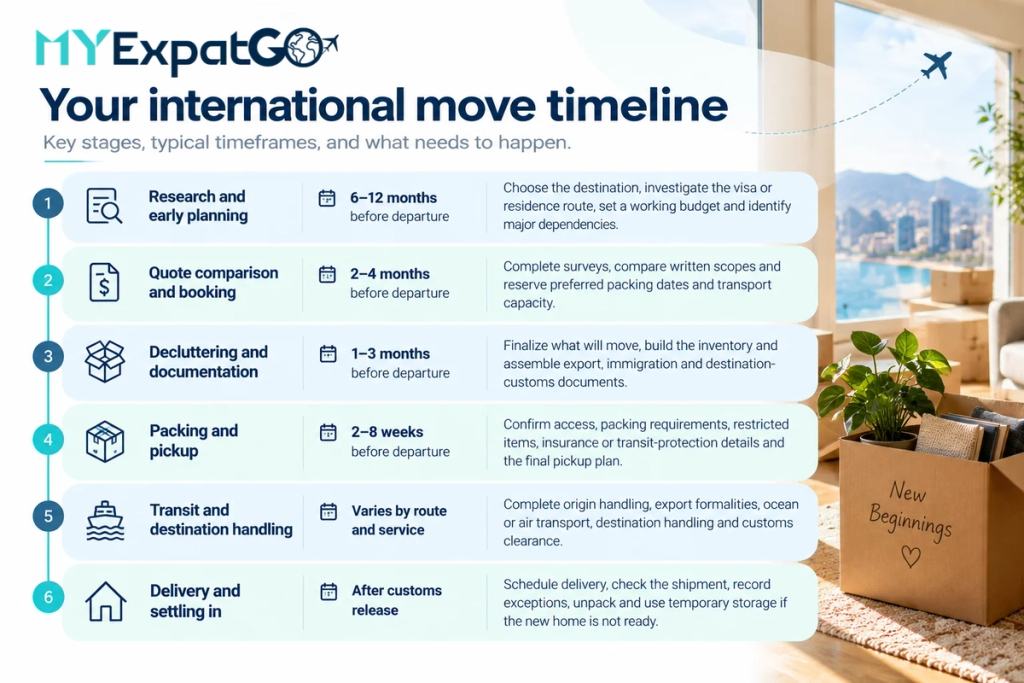
This is a planning framework rather than a guaranteed schedule. Some tasks overlap, and immigration, pets, vehicles, school admissions, property transactions or specialist items may require longer lead times.
6–12 months before: choose the destination and immigration route
Begin with the right to live in the destination country. “Europe” is not one visa system: EU guidance directs applicants to the national authorities of the country where they plan to live, because individual countries issue their own visas and residence permits. The United Kingdom also has its own immigration and customs processes.
At this stage, confirm:
- The country and likely city or region.
- The visa or residence category that fits your work, study, family, retirement or remote-work situation.
- Whether an employer, school, spouse, income threshold, insurance policy or local address is a prerequisite.
- Which documents may need certified copies, apostilles or translations.
- Whether your goods can arrive before you, only after you establish residence, or within a particular customs-relief window.
Visa timing and shipping timing are connected. A residence document, proof of a new address or evidence of a genuine transfer of residence may be needed for customs relief, clearance or final delivery. For example, UK Transfer of Residence relief has eligibility and ownership/use conditions and requires an HMRC application; German guidance likewise ties relief to residence, prior use and import deadlines. The exact rules differ by country, so check the destination authority and your mover’s destination agent before dispatching the shipment.
This is also the time to create the first move budget. Include more than freight: professional packing, origin and destination handling, customs processing, insurance or transit protection, difficult access, storage, temporary accommodation, pet transport, vehicle handling and possible duties or taxes should all be considered.
3–6 months before: decide what will actually move
The volume of the shipment affects the price, shipping method, survey result, packing time and customs inventory. Begin room by room and classify items as ship, sell, donate, store or replace.
Do this before requesting final quotes where possible. A quote based on a fully furnished three-bedroom home will not remain comparable if half the furniture is later removed—or if a garage, attic or storage unit is added at the last minute.
Create a working inventory that identifies:
- Furniture and approximate dimensions.
- Estimated box counts by room.
- Fragile, high-value, oversized or unusually heavy items.
- Items requiring crating, dismantling or reassembly.
- Goods located in an attic, garage, basement or second pickup location.
- Items that will not be shipped.
Professional international-moving guidance treats the pre-move survey as more than a quick volume estimate. It should identify access conditions, unusual goods, specialist handling, items requiring dismantling, excluded items, packing methods and restricted or hazardous goods.
A stable inventory also makes quote comparison more meaningful. If each mover is pricing a different volume or service scope, the lowest total may not be the lowest comparable price.
Related reading: What Should You Ship to Europe? A Practical Guide to Selling, Storing, or Replacing Your Belongings
2–4 months before: request surveys and compare quotes
For most USA-to-Europe moves, begin mover conversations at least two to three months before the preferred packing date; allow more time for summer, school-holiday or end-of-month moves. FIDI advises scheduling well in advance, moving outside peak season where possible and obtaining at least three written quotes. Published mover recommendations vary from roughly six weeks to twelve weeks, which is exactly why earlier comparison gives you more flexibility rather than guaranteeing a date.
Request an in-home or detailed video survey from each shortlisted mover. Give every company the same route, inventory, service requirements and timing assumptions, then compare:
- Estimated volume or weight.
- Shipping method: dedicated full container, LCL, groupage or air freight.
- Origin packing, collection and warehouse handling.
- Export formalities and port or terminal charges.
- Ocean or air freight.
- Destination customs clearance and terminal handling.
- Final delivery, unpacking, debris removal and reassembly.
- Storage, shuttle, stairs, elevators, long carries or difficult-access charges.
- Exclusions, allowances and charges that remain conditional.
- The start and end points used for the stated transit time.
The U.S. Federal Maritime Commission advises consumers using ocean services to verify that prospective movers are appropriately licensed or registered and bonded, obtain several written estimates based on an inspection, avoid automatically choosing the cheapest quote and not wait until the last minute.
Do not book only on the headline price. A cheaper quotation can become more expensive if destination handling, customs work, storage, port charges or difficult-access delivery are excluded.
Related reading: How to Compare International Moving Quotes: 15 Questions to Ask Before You Choose a Mover
1–3 months before: finalize the inventory and documents
Once a mover is selected, turn the working inventory into the shipment that will actually be packed. Remove prohibited or restricted goods, separate anything traveling with you, and prepare a small “arrival shipment” if needed.
Documentation requirements depend on the destination and your circumstances, but the working file may include:
- Passports and relevant visas or residence permits.
- Proof of previous U.S. residence.
- Proof of the new European address or intention to establish residence.
- A detailed, itemized inventory or packing list.
- Customs-relief applications and supporting evidence.
- A declaration of value for insurance or transit protection.
- Powers of attorney or authorization forms requested by the mover or customs representative.
- Purchase or ownership evidence for vehicles, valuable items or recently acquired goods.
On the U.S. export side, Electronic Export Information may be required for household goods shipped as cargo to a foreign destination when the relevant value threshold or another mandatory filing condition is met. U.S. Customs and Border Protection specifically notes the filing requirement for personal or household goods valued above $2,500 when sent to a destination other than Canada; confirm with the mover who will file and supply the resulting reference.
Destination customs relief should not be treated as automatic. The EU framework allows qualifying personal property to enter free of import duties when a person transfers normal residence from a non-EU country, but eligibility, prior-residence and prior-use conditions apply, and the national customs process still has to be completed. The UK uses its own Transfer of Residence procedure and permits an application before goods are shipped.
2–8 weeks before: confirm packing and pickup
As the packing date approaches, confirm the operational details in writing:
- Final pack and pickup dates, plus any arrival window.
- Who is packing each category of goods.
- Whether owner-packed boxes are accepted and how they affect cover.
- Building rules, elevator bookings, parking permits and loading access.
- Crating, appliance preparation and furniture dismantling.
- Items the crew will refuse to pack.
- The final inventory and declaration of value.
- Contact details for the origin coordinator and destination agent.
- Where the shipment will wait if it cannot depart immediately.
Do not pack passports, immigration records, medication, essential electronics, keys, irreplaceable documents or valuables into the main sea shipment. Keep a separate travel-and-arrival kit for the period when you will be living without your household goods.
Restricted-item rules vary by carrier, transport mode and country. Common problem categories include flammables, aerosols, pressurized containers, certain batteries, chemicals, weapons, alcohol, food, plants and soil; obtain the mover’s written list instead of relying on a generic checklist.
Packing week: professional packing and export preparation
On packing day, the crew records and numbers the packed items, prepares the packing list and loads the shipment for transport to the origin warehouse or export terminal. Review the inventory before signing it. Descriptions such as “miscellaneous” may be insufficient for customs or claims purposes; the list should allow the shipment to be identified sensibly.
After pickup, the shipment may still need to be:
- Checked and measured at the origin warehouse.
- Placed into a lift van or container.
- Combined with other customers’ goods if using groupage or another shared service.
- Moved inland to the departure port or airport.
- Matched to carrier space and a sailing or flight.
- Cleared for export and supported by transport documents.
This is why the pickup date is not the same as the sailing date. A dedicated container may move directly once loading, documentation and carrier arrangements are complete. A groupage shipment may wait for enough compatible cargo to complete the consolidation, adding time before the ocean leg begins.
In transit: the ocean crossing is only one stage
A vessel’s advertised port-to-port transit is not a complete moving timeline. A true door-to-door schedule also includes origin collection, warehouse handling, export processing, port cutoff dates, consolidation where applicable, destination-terminal handling, deconsolidation, customs clearance and inland delivery.
For planning purposes, published USA-to-Europe household-goods ranges commonly place dedicated-container services around six to twelve weeks door to door and groupage around eight to sixteen weeks. Air freight is often quoted around one to three weeks including handling, although route and clearance conditions still matter. These broad ranges should not replace the written estimate for your specific route.
While the shipment is moving, stay responsive. The destination agent may request signed customs forms, a residence document, proof of address, an updated arrival date or authority to clear the goods. Sending the destination file early gives the agent time to identify missing information before the container arrives.
Arrival in Europe: customs, delivery and storage
Arrival at the port does not mean the shipment is ready for delivery. The carrier or destination agent must receive the arrival documents, arrange terminal handling, submit the customs declaration and obtain release. Customs may clear the shipment from the documents or select it for an examination.
After release, the destination team confirms:
- The delivery address and contact number.
- Road, parking, elevator and building access.
- Whether a smaller shuttle vehicle is required.
- Which items need reassembly or placement.
- Whether unpacking and packaging removal are included.
- Whether the home is ready or storage is required.
If the residence is not ready, destination storage can bridge the gap. Arrange it before arrival and ask about warehouse handling, monthly minimums, redelivery charges and notice periods. Leaving released goods at a port or terminal while deciding what to do can trigger avoidable storage or detention-related costs; professional moving guidelines specifically require destination agents to monitor and report potential port storage or rent.
Need Temporary Accommodation at Arrival?
Comfortable, furnished accommodation while you settle into your new city — without the stress of searching from abroad. From serviced apartments and aparthotels to furnished homes and hotels, find accommodation that fits your destination, dates, budget and lifestyle.
At delivery, check item numbers and visible condition against the inventory. Record missing or damaged items on the delivery paperwork before signing, take photographs and follow the mover’s claim-notification process promptly.
What most often causes delays?
International-moving schedules usually slip at the handoffs between stages rather than during the ocean crossing alone. Common causes include:
- Visa or residence timing: The document needed to establish eligibility or complete customs is not yet available.
- Incomplete customs files: Missing signatures, proof of address, inventory details or relief approvals prevent the destination agent from lodging or completing the entry.
- A changing shipment: Added furniture or unlisted storage areas change the volume, price, container plan or packing time.
- Late booking: Preferred pack dates, crews, containers or vessel space may be unavailable, especially in summer or around school holidays.
- Shared-container consolidation: Groupage can wait for compatible shipments before departure and for deconsolidation after arrival.
- Carrier or port disruption: Schedule changes, missed connections, weather and congestion can affect movement.
- Customs examination: Inspection adds a step that the mover cannot guarantee or control.
- Restricted items: Undeclared batteries, chemicals, food, plants or other controlled goods can stop or complicate the shipment.
- Destination access: Narrow streets, parking restrictions, stairs, small elevators or an unavailable residence may require a shuttle, extra labor or storage.
- Slow responses: A shipment can be physically ready while waiting for the customer to approve charges, send a document or confirm delivery.
A useful contingency is to avoid scheduling the main shipment to arrive on the same day you do. Build a buffer and plan how you will live, work and sleep while the shipment remains in transit.
When air freight makes sense
Air freight is not usually economical for an entire furnished home, but it can solve a timing problem. Consider it for a small, carefully selected shipment when:
- You must begin work before the sea shipment arrives.
- You are moving with children and need essential equipment immediately.
- Temporary housing is unfurnished or only partly equipped.
- The main shipment is using slower groupage.
- A small collection of professional equipment is time-critical.
A practical split is to travel with immediate essentials, send a limited air shipment for the first few weeks and place furniture and non-urgent belongings into the sea shipment. Published planning guidance commonly places air freight around one to three weeks door to door, compared with several weeks or months for ocean services.
Air is faster, not delay-proof. Export screening, restricted-item rules, flight capacity, customs clearance and last-mile delivery still apply. Ask for a complete door-to-door air-freight scope rather than a flight-time estimate.
Build the timeline backward
Start with the date you need to function in Europe—not simply the day you want to leave the USA. Then work backward from four milestones:
- Ready-to-live date: When must housing, school, work and essential belongings be operational?
- Expected delivery window: What door-to-door range has the mover provided, and what buffer will you add?
- Packing date: When must the final inventory, customs file and access arrangements be complete?
- Decision date: When must quotes be compared and the mover booked to preserve the preferred pack date?
Treat dependencies separately. A visa decision may control when you can establish residence; a residence document may affect customs relief; a final inventory controls volume; volume affects shipping method; and the shipping method affects the likely delivery window.
Need a timeline built around your move?
MYEXPATGO’s Custom Timeline Development service creates a personalized, step-by-step roadmap covering pre-departure, travel, arrival and settling in. The current listed price is $130.
Frequently asked questions
How long does it take to move from the USA to Europe?
Allow six to twelve months for the complete planning process if visas, housing, family arrangements and household-goods shipping are included. After pickup, broad door-to-door planning ranges are often around six to twelve weeks for a dedicated container, eight to sixteen weeks for groupage and one to three weeks for air freight, but the actual route and written mover schedule should govern.
How early should an international mover be booked?
Begin comparing movers about two to four months before the preferred pack date and earlier for summer or school-holiday moves. Industry recommendations vary, but eight to twelve weeks is a common planning window because surveys, quote comparison, documents and transport scheduling all need time.
Is ocean transit the same as door-to-door transit?
No. Ocean transit usually describes only the port-to-port movement. Door-to-door timing also includes pickup, origin handling, export processing, possible consolidation, destination handling, customs clearance and final delivery.
Why can groupage take longer than a full container?
Groupage combines several household shipments into one container. It can reduce cost for smaller moves, but the shipment may wait for consolidation before departure and deconsolidation after arrival, so the schedule is generally less predictable.
Can belongings be shipped before the visa is approved?
Sometimes, but doing so can create customs, storage or tax problems if the destination requires residence evidence or prior approval. Check the destination-country rules and obtain written guidance from the mover’s destination agent before dispatching the shipment. EU and UK relief procedures each impose specific eligibility and timing conditions.
What should travel with me rather than in the sea shipment?
Keep passports, visa documents, medication, essential records, keys, irreplaceable items, work equipment needed immediately and enough clothing for the expected shipping window plus a delay buffer. Confirm airline and destination rules for any controlled or restricted item.
Ready to plan your move?
Get up to five free quotes from vetted international moving companies.
