
Moving Tips
What Should You Ship to Europe? A Practical Guide to Selling, Storing, or Replacing Your Belongings
Deciding what to take overseas can significantly affect your moving quote. This practical guide helps you determine which furniture, appliances, electronics, mattresses, valuables, and everyday belongings to ship, sell, store, donate, or replace locally.

Moving from the USA to Europe does not mean choosing between taking everything and starting from zero. The practical answer is usually a mix: ship the belongings that are valuable, useful, compatible, and difficult to replace; sell or donate bulky low-value items; store only what has a clear future purpose; and buy locally when European sizing, voltage, or housing makes replacement more sensible.
This decision matters because an international household-goods quote is normally based partly on the volume or weight of what you ship. The Federal Maritime Commission advises consumers to obtain written estimates after an actual inspection because online, telephone, and room-count estimates can be inaccurate.
Start with the destination home
Before deciding whether a sofa, dining table, or king-size bed is worth shipping, find out whether it will work in the home where it will be delivered. Measure the rooms, doors, hallways, elevator, stair turns, and where relevant, the distance from the delivery vehicle to the entrance.
Ask these questions:
- Will the item fit through the building and into the intended room?
- Is there an elevator, and does the building allow move-ins at any time?
- Will the home be furnished, partly furnished, or empty?
- Does the lease prohibit wall mounting, outdoor storage, or certain appliances?
- Are wardrobes, kitchen appliances, or other large fixtures already included?
- Is this a permanent home or temporary accommodation?
If you have not secured long-term housing, avoid planning an entire shipment around guessed room sizes. A smaller first shipment, temporary storage, or delayed shipment may provide useful flexibility, subject to the customs deadlines at your destination.
Use the six-factor test
For each large or expensive item, compare six factors rather than asking only, “Do I like it?”
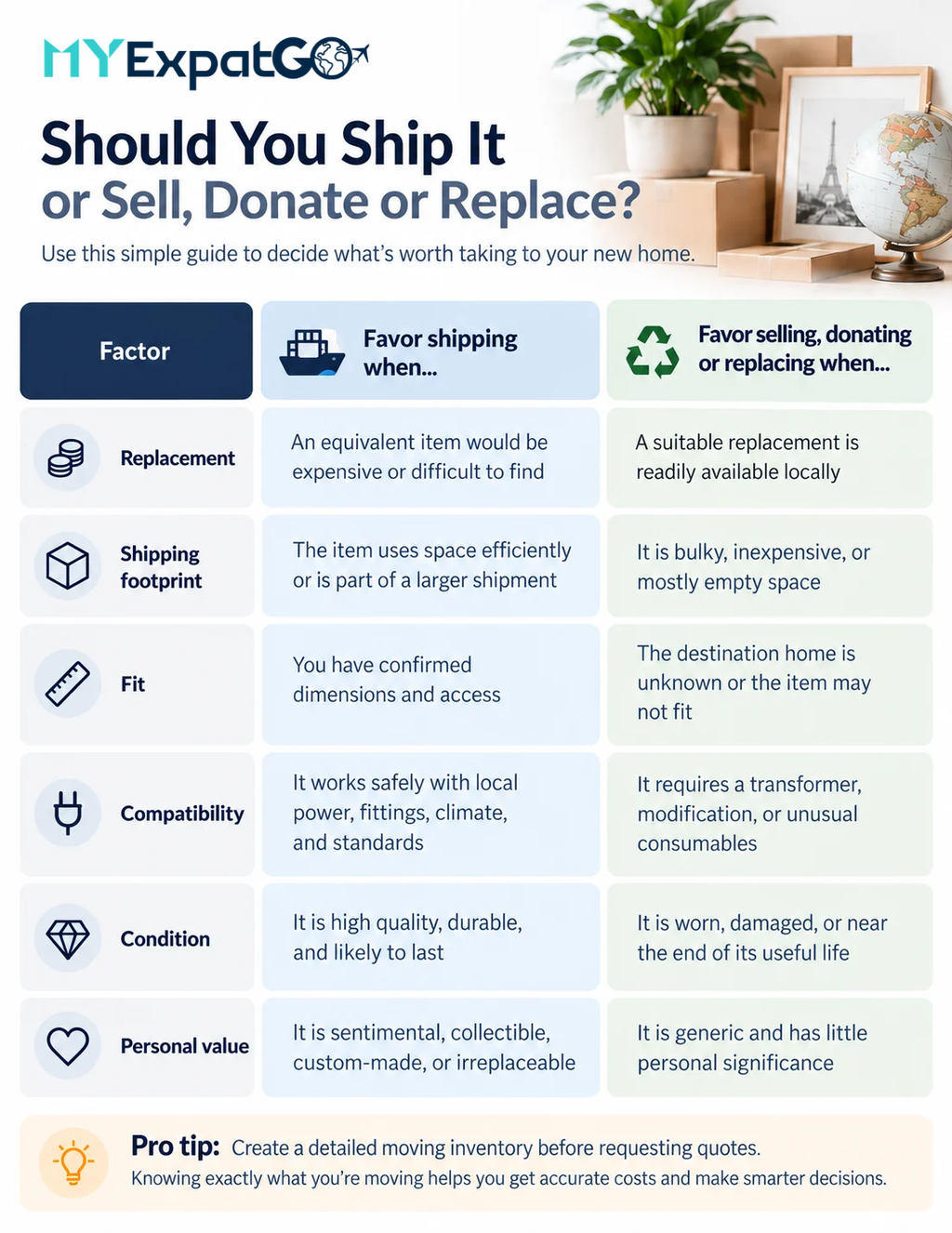
A useful financial comparison is:
Cost to keep and ship = incremental moving cost + packing/crating + insurance + any modification + possible storage
Cost to replace = local purchase price + delivery + assembly + disposal of the old item
Do not compare an item’s original purchase price with the cost of shipping it. Compare the full cost of keeping it with the cost and difficulty of obtaining an acceptable replacement after arrival.
Not sure how much your shortlist adds up to? Use the MYEXPATGO inventory tool to estimate your shipment size before deciding what stays and what goes. Create one estimate with all possible items and another with only the essentials to see how decluttering could change the shipment.International Moving Cost EstimatorBenchmark-based price ranges for your route.Estimate My Shipment Size
Furniture worth shipping
Furniture is most likely to justify international shipping when it combines quality, longevity, good fit, and high replacement cost. Strong candidates may include:
- Solid-wood furniture in excellent condition
- Designer, antique, custom-made, or collectible pieces
- A high-quality sofa or chair that fits the destination home
- An ergonomic desk chair or specialist furniture you rely on
- Coordinated pieces that would be costly to recreate
- Furniture with genuine family or sentimental value
Even an excellent piece should pass the access test. Confirm its packed dimensions, whether it can be disassembled, and whether the mover will rebuild it at delivery. International furniture should be clean and dry before packing; detachable parts should be removed where appropriate, hardware should be labelled, and corners and finished surfaces need protection.
Furniture usually better replaced
Selling, donating, or recycling is often more sensible for:
- Low-cost flat-pack or particleboard furniture
- Worn sofas, damaged tables, and items due for replacement
- Oversized sectionals that cannot be separated
- Large entertainment centers designed for a specific room
- Inexpensive bookcases and storage cubes
- Furniture that will remain boxed in paid storage after arrival
The key is not whether furniture is “cheap” or “expensive” in isolation. A $400 item that occupies substantial shipment space may be a weak candidate, while a compact $400 item that is hard to replace may still deserve a place.
Appliances and voltage
Most large US appliances are poor shipping candidates unless the manufacturer confirms compatibility and installation requirements for the exact model. Standard US household power is 120 V at 60 Hz, while the UK and most continental European destinations use 230 V at 50 Hz; continental Europe commonly uses Type C and related sockets, while the UK uses Type G.
A plug adapter changes only the plug shape. It does not change voltage, and a transformer changes voltage but generally does not change frequency. That distinction makes refrigerators, washers, dryers, microwaves, coffee makers, vacuums, lamps, hair tools, and motorized equipment especially important to check.
Usually replace locally
- Refrigerators and freezers
- Washing machines and dryers
- Dishwashers
- Ovens, ranges, and large microwaves
- Window air conditioners and space heaters
- Single-voltage kitchen appliances
- Hair dryers, curling irons, and other high-wattage heat devices
- Corded power tools that are not rated for local voltage and frequency
Buying major appliances locally also makes it easier to match the available space, connectors, energy expectations, servicing network, and warranty. Appliances sold in the EU use standardized energy labels from A to G, and the European Commission’s EPREL database lets consumers review covered models’ energy and environmental information.
May be worth taking
Check the label or power supply for wording such as “Input: 100–240 V, 50/60 Hz.” Multi-voltage phone chargers, laptop power supplies, camera chargers, and some small electronics may need only the correct plug adapter.
Do not assume that every modern device is dual voltage. Check the rating plate for each item and ask the manufacturer if the label is unclear. For high-value equipment, also check warranty coverage, replacement parts, tuners or region-dependent features, and whether an insurer will cover it in transit.
Electronics
Separate electronics into three groups:
Carry personally
Carry passports, data backups, phones, laptops, small cameras, and compact high-value devices with you where practical. The FMC advises against putting cash, jewelry, coins, and similarly valuable personal items into an ocean household-goods shipment.
Spare lithium batteries and power banks require special handling for passenger travel. IATA says spare batteries must be protected against short circuits and carried in hand baggage, not checked baggage; airline approval may be needed for batteries above 100 Wh.
Consider shipping
Desktop computers, monitors, audio systems, game consoles, and specialty equipment may be reasonable to ship if they are compatible, properly packed, and included on a detailed inventory. Record makes, models, serial numbers, condition, photographs, and replacement values before collection; the FMC specifically recommends accurate descriptions and serial numbers for larger electronics.
Consider replacing
Replace electronics when their resale value is low, their power requirements are unsuitable, they depend on region-specific services, or the combined packing, shipping, insurance, and possible repair cost approaches the price of a local model. Older televisions, printers, inexpensive monitors, and single-voltage devices often fall into this category.
Mattresses and bed frames
A mattress can be worth shipping if it is relatively new, exceptionally comfortable, medically important, or expensive to replace. However, it is bulky, difficult to protect from moisture, and may lock you into a non-standard frame and bedding size.
UK and continental European mattress dimensions are not identical. Common UK sizes include 135 x 190 cm for a double and 150 x 200 cm for a king, while common European options include 140 x 200 cm, 160 x 200 cm, and 180 x 200 cm. Before shipping a US mattress, confirm:
- Its exact dimensions, not only its size name
- Whether it fits the destination bedroom and access route
- Whether the existing frame can be disassembled and rebuilt
- Whether replacement sheets and protectors will be easy to find
- Whether the mover can keep it clean and dry in transit
- Whether its remaining life justifies the shipment space
An older mass-market mattress is usually a replacement candidate. A premium mattress that reliably solves a comfort or health need deserves a more careful cost comparison.
Sentimental and valuable items
Sentimental value changes the calculation because replacement cost alone cannot capture it. Family photographs, letters, heirlooms, children’s keepsakes, original artwork, collections, and handmade objects may be worth shipping even when their resale value is modest.
Use three different handling categories:
- Carry with you: passports, essential records, jewelry, small heirlooms, irreplaceable digital backups, and compact valuables
- Professionally pack or crate: artwork, mirrors, antiques, instruments, sculpture, and fragile collections
- Document before shipping: photograph each item, retain appraisals and receipts, record condition, and confirm the insurance valuation method and exclusions
Do not label a valuable object merely as “decor” or “glassware.” The FMC recommends specific descriptions on the mover’s inventory and warns consumers to review insurance terms because some policies may protect only against total loss rather than routine transit damage.
Antiques and objects made with ivory, coral, certain woods, skins, feathers, or other wildlife materials can trigger CITES or cultural-property controls. Check the exact material, age, origin, and destination rules before including such an item.
Outdoor and garage items
High-quality bicycles, sports equipment, patio furniture, and hand tools may justify shipping if they are in good condition and suitable for your future home. The practical problem is contamination and hazardous contents rather than the object alone.
Clean outdoor furniture, bicycles, plant pots, camping equipment, tools, and lawn equipment thoroughly. Remove soil, seeds, insects, standing water, fuel, gas canisters, and other residues. The FMC advises consulting the mover before shipping gas-powered grills or lawnmowers and keeping outdoor items free from dirt and insects.
Usually leave behind:
- Propane cylinders and fuel canisters
- Gasoline, oil, paint, solvents, pesticides, and fertilizers
- Aerosols and many household chemicals
- Plants, soil, seeds, and untreated natural materials unless specifically permitted
- Rusted or low-value garden tools
- Bulky outdoor equipment with no confirmed use at the destination
EU plant-health rules generally require a phytosanitary certificate for plants and many plant products entering from outside the EU, and some high-risk plants are prohibited. Do not pack houseplants or seed collections on the assumption that personal ownership creates an exemption.
What not to ship internationally
The exact prohibited and restricted list depends on the carrier, transport mode, transit route, and destination country. At minimum, ask the mover about:
- Flammable liquids, paint, solvents, gasoline, and lighter fluid
- Aerosols, compressed gases, propane tanks, and fire extinguishers
- Fireworks, ammunition, firearms, and weapons
- Loose batteries, damaged batteries, and some battery-powered equipment
- Pesticides, fertilizer, bleach, and corrosive chemicals
- Food, alcohol, tobacco, and medicines
- Plants, seeds, soil, untreated wood, and animal products
- Cash, jewelry, negotiable instruments, and irreplaceable documents
- Items made from endangered species or controlled cultural materials
EU imports can be prohibited or restricted for public safety, health, environmental, cultural-property, and intellectual-property reasons, among others. The UK likewise restricts or bans categories including firearms, explosives, certain weapons, endangered species products, and some food and plants.
Treat every mover’s prohibited-items list as shipment-specific. Never hide or misdescribe an item to get it accepted.
When storage makes sense
Storage is useful when it buys time for a specific decision. It becomes expensive when it merely postpones decluttering.
Temporary storage
Consider temporary storage when:
- You will live in furnished or temporary housing first
- Your long-term home is not yet confirmed
- Your shipment and lease dates do not align
- Renovation or construction will delay move-in
- You need to separate an essential shipment from later belongings
- Your employer or relocation package covers a defined storage period
Ask whether storage is at origin, at destination, or storage in transit, because each option affects access, customs timing, handling, insurance, and redelivery charges.
Long-term storage
Long-term storage is easier to justify for documents, archives, heirlooms, collections, seasonal belongings, or items intended for a known return date. It is harder to justify for replaceable furniture and everyday household goods.
Before signing a storage contract, calculate the full expected cost, including collection, monthly fees, insurance, access charges, and final delivery. Set a review date. If there is no likely use, recipient, return date, or emotional reason to preserve an item, selling or donating it may be the more honest decision.
Customs can affect the decision
Used household goods may qualify for transfer-of-residence relief, but eligibility is not automatic. Under EU rules, qualifying personal property has generally been possessed and used for at least six months, the person’s normal residence has been outside the EU customs territory for at least 12 continuous months, and the goods are imported within 12 months of establishing the new residence.
Goods admitted duty-free under the EU transfer-of-residence rules generally cannot be lent, hired, pledged, or transferred during the first 12 months without notifying the authorities, or duties may become payable. This matters if the plan is to ship furniture and sell it soon after arrival.
The UK operates a separate Transfer of Residence process. Its guidance generally requires 12 months of prior residence outside the UK, import within 12 months of moving, six months’ prior possession, and continued use for the same purpose.
Rules and documents vary by country and personal circumstances. Verify the destination authority’s current requirements before shipping, especially for newly purchased items, second homes, gifts, inherited property, vehicles, alcohol, tobacco, and restricted goods.
How your choices affect the quote
Reducing the inventory can lower the chargeable shipment size, but it can also change the most suitable service. A smaller shipment may move by groupage or another shared-container service, while a larger shipment may justify a dedicated container. The relationship is not always linear because minimum charges, collection, packing, port, customs, and delivery services may still apply.
A moving quote can change with:
- Total volume or chargeable weight
- Number and type of cartons
- Professional packing and unpacking
- Custom crating for artwork or fragile items
- Furniture disassembly and reassembly
- Long-carry, stairs, elevators, parking, or shuttle-vehicle needs
- Origin or destination storage
- Customs-clearance and inspection charges
- Restricted-access or difficult-delivery locations
- Transit insurance and declared values
- Special handling for pianos, safes, antiques, fitness equipment, or oversized items
The FMC recommends several written estimates based on an inspection of the goods and warns that excluded costs—such as some terminal-handling charges—can appear later. For moves by sea to or from the United States, verify that the international mover or intermediary is licensed or registered and bonded with the FMC.
Ship, sell, store, or donate
Use this final sorting framework room by room:
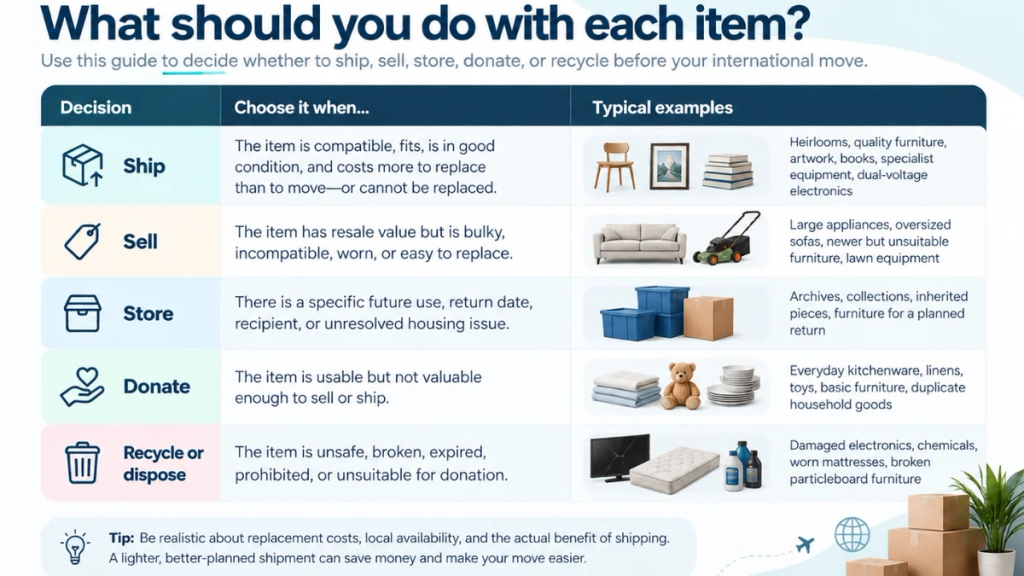
Label items physically or in a digital inventory, then repeat the process once more before the moving survey. The first pass identifies obvious decisions; the second usually finds duplicates and “just in case” items that do not justify their space.
Moving belongings checklist
Before requesting final quotes:
- Confirm the destination country, city, and likely housing type
- Measure large items and all known access points
- Photograph valuable and fragile belongings
- Check voltage, frequency, plug, installation, and warranty compatibility
- Compare local replacement prices for large items
- Separate carry-on valuables and essential documents
- Remove prohibited, hazardous, agricultural, and perishable goods
- Decide whether storage will be at origin or destination
- Build a detailed, room-by-room inventory
- Estimate shipment volume with MYEXPATGO
- Obtain several survey-based written quotes using the same inventory
- Compare included, excluded, conditional, and optional charges
- Confirm customs documents and relief eligibility with the destination authority
- Review transit insurance, exclusions, deductibles, and valuation basis
Frequently asked questions
Should I ship my furniture to Europe?
Ship furniture when it is high quality, difficult or expensive to replace, suitable for the destination home, and efficient enough to justify the space. Sell or donate low-cost, worn, oversized, or uncertain-fit furniture. Measure the destination access route before deciding.
Is it worth shipping a mattress to Europe?
It may be worth shipping a relatively new premium or specialist mattress, particularly when comfort is difficult to replace. Older standard mattresses are often better replaced because they occupy substantial volume and US, UK, and continental European bed dimensions differ.
Can US appliances be used in Europe?
Only when the equipment is compatible with the local voltage and frequency or can be used safely with suitable equipment. A plug adapter does not convert voltage. Check the rating label; devices marked 100–240 V and 50/60 Hz are generally the easiest to use internationally.
What items should not go in an overseas moving shipment?
Do not include anything your mover or destination prohibits. Common problem categories include fuel, propane, paint, solvents, aerosols, pesticides, firearms, ammunition, plants, soil, some food, loose batteries, cash, jewelry, and important personal documents.
Should belongings be stored instead of shipped?
Storage can make sense during temporary housing, an uncertain move, renovation, or a planned return. It is usually a poor long-term choice for ordinary replaceable goods unless the future use and total storage cost are clear.
Does selling furniture lower an international moving quote?
Usually, reducing shipment volume or weight helps, but the savings may not match the percentage removed because minimum charges and fixed services still apply. Final pricing should be based on a survey of the actual goods, with all included and excluded charges stated in writing.
Use the MYEXPATGO inventory tool to estimate your shipment size before deciding what stays and what goes.
Compare a “ship more” and “ship less” version of your inventory, then use the final estimate when requesting moving quotes. Self Survey tool available in Q4 2026 through the Founding Members program.


