
Moving Tips
Customs When Moving Household Goods from the USA to Europe: 2026 Guide
A practical 2026 guide to customs relief, inventories and country-specific documents for Americans shipping used household goods to Europe.

Moving household goods from the USA to Europe is not simply a matter of packing, shipping and collecting your boxes. Your shipment must be declared to customs, and qualifying for relief from import duty and VAT usually depends on proving that you are genuinely transferring your normal residence—not importing new purchases or commercial goods.
For moves to Germany, Spain, France or Italy, a shared body of European Union rules provides the foundation for transfer-of-residence relief. The United Kingdom operates a separate system and normally requires advance approval through HM Revenue & Customs’ ToR1 process.
The practical lesson is simple: start the customs file before packing day. A clear inventory, evidence of your former and new homes, and country-specific forms can prevent delays, storage charges and unexpected tax bills.
Important: This guide was reviewed on September 28, 2026 and focuses on household moves from the United States to the UK, Germany, Spain, France and Italy. Customs procedures can change and individual circumstances vary. This is general information, not legal, tax or customs advice. Confirm current requirements with the destination customs authority and your licensed customs agent or international mover before shipping.
The basic rule
The EU allows personal property to be imported free of customs duty when an individual transfers their normal residence from a non-EU country into the EU, subject to conditions. A related EU directive provides a corresponding import-VAT exemption for qualifying personal property.
In a standard case, expect these core tests:
- Residence test: You normally lived outside the EU customs territory for at least 12 continuous months before the move.
- Ownership and use test: You possessed and, for non-consumable goods, used the belongings at your former residence for at least six months before leaving.
- Same-use test: You will use the belongings for the same personal or household purpose in your new residence.
- Import window: You normally import the goods within 12 months after establishing your new normal residence.
- No early disposal: You generally cannot lend, rent, pledge, give away or sell relieved goods during the first 12 months without notifying customs and potentially paying duty or VAT.
Relief is not automatic. The destination authority must be satisfied that you and the goods qualify. National procedures, forms and evidence differ even where EU law supplies the common framework.
What is personal property?
Eligible property can include furniture, clothing, linens, bicycles, private vehicles and trailers, camping caravans, pleasure craft, normal household provisions, pets and some portable professional instruments. The nature and quantity must be consistent with personal or household use rather than resale or business activity.
Alcohol, tobacco, commercial vehicles and most non-portable professional equipment are generally excluded from transfer-of-residence relief. Restricted items—such as firearms, certain plants, animal products, wildlife materials or protected-species goods—may require separate licences or may be prohibited regardless of whether the rest of the shipment qualifies.
New purchases are a frequent problem. If an item has not been possessed and used for the required period, list it separately and ask the customs representative whether duty and import VAT will apply. Do not describe new goods as used household effects.
Documents to prepare
Exact requirements depend on the destination and the facts of the move, but a strong customs file commonly includes:
- Passport identity page for the owner of the goods.
- Visa, residence permit or other evidence of permission to reside, where applicable.
- Evidence of the former US residence, such as a recent lease, mortgage statement, utility bill or bank statement.
- Evidence of the new European residence, such as a lease, registration certificate, employment contract, utility bill, hotel booking or host declaration accepted by the relevant authority.
- A detailed packing inventory showing numbered packages and their contents.
- A signed declaration that the goods are used personal effects, not for sale, and will continue to serve the same purpose.
- Transport documents, such as the ocean bill of lading or air waybill.
- A power of attorney or letter of authority if a mover or customs broker will act for you.
- Receipts, purchase records, registrations or photographs for vehicles, valuable goods or items whose ownership and period of use may need proof.
- Any destination-specific relief form or approval number.
The UK’s ToR1 application specifically requests an item list, passport page, evidence of a UK address and evidence of the former non-UK address. A temporary-accommodation booking or a statement from the person providing accommodation may be accepted if a permanent UK address is not yet available.
On the US export side, Electronic Export Information is generally filed through the Automated Export System when a commodity under an individual Schedule B number exceeds $2,500 or when another mandatory filing rule applies. US government guidance specifically states that baggage or containers containing personal or household goods valued over $2,500 and sent to a foreign destination other than Canada require EEI filing and an Internal Transaction Number for the carrier; the filer or authorized agent should confirm how the shipment is classified and whether an exemption applies.
Build a customs-ready inventory
A customs inventory and a mover’s packing list are related, but they are not always identical. The mover’s list may be created during packing; the customs file must also help the authority understand what is being imported, how many packages are involved, whether the items are used and whether any category needs separate treatment.
Use numbered cartons and match those numbers to the inventory. Group ordinary items sensibly, but identify valuable, regulated or unusual property individually.
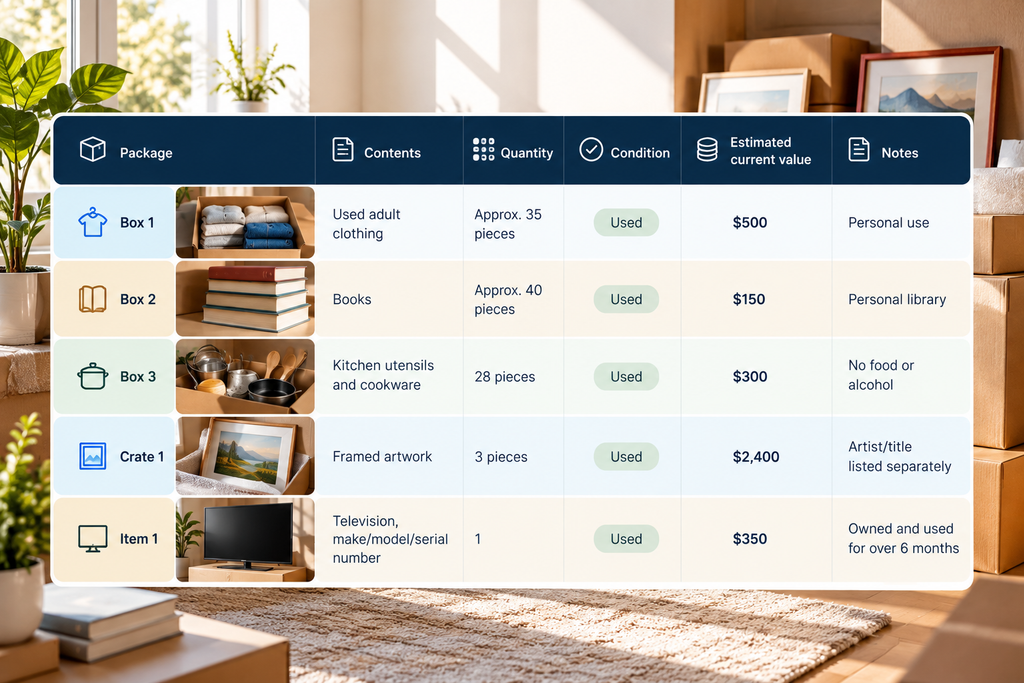
For the UK ToR1 application, HMRC permits sensible groupings such as clothing, books, cutlery and crockery and says that original cost, current value and brand are not required for the general item list. France, by contrast, requires a detailed, estimated, dated and signed inventory in two copies, so an inventory template used across destinations should include estimated current values even if the UK does not require them.
Follow these inventory rules:
- Use plain descriptions such as “used bedroom furniture,” not vague labels such as “miscellaneous.”
- State quantities or reasonable estimates for grouped items.
- Separate new goods, alcohol, tobacco, food, weapons, medicines, plants and animal products.
- Record makes, models, serial numbers and realistic current values for electronics, artwork and other valuable items.
- Keep the inventory consistent across the quote, packing survey, insurance valuation and customs declaration.
- Sign and date the final version when the destination procedure requires it.
Insurance value and customs value are not necessarily interchangeable. Ask the mover or insurer how to complete each declaration, and avoid intentionally understating values.
Country requirements
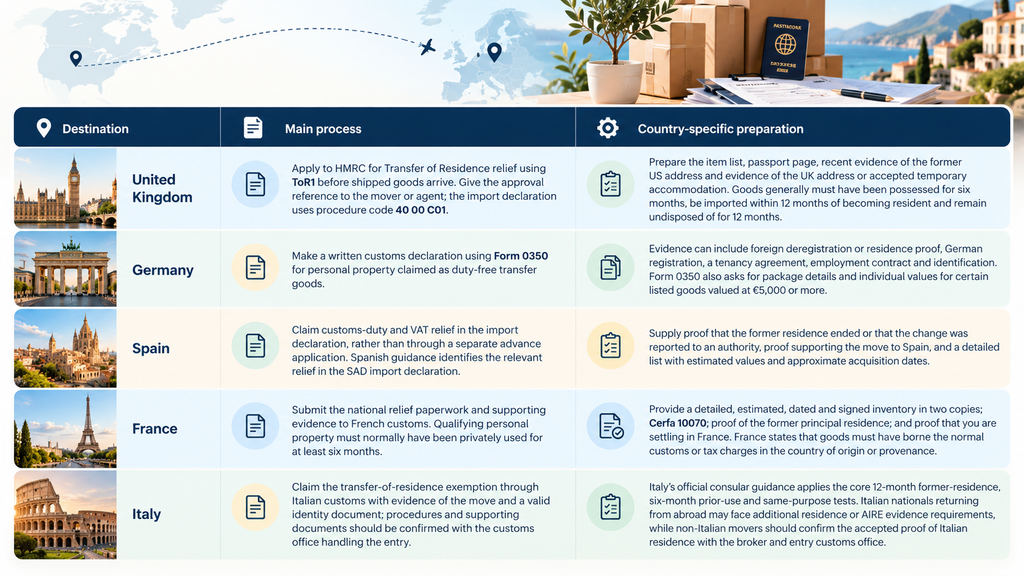
Europe is not one customs destination. The UK is outside the EU customs territory, while Germany, Spain, France and Italy apply EU-level relief rules through national customs processes.
United Kingdom
Do not wait until the vessel is approaching port to start ToR1. HMRC says approval should be obtained before claiming the relief, and shipped goods should carry the unique reference number on the import declaration. Without a valid reference, the shipment may be billed for import duties and administrative charges.
The UK allows multiple consignments within the permitted period. Relief does not apply to goods from a secondary or holiday home, and special rules apply to students, marriage-related moves, animals and vehicles.
Germany
Germany treats eligible belongings as property moved in connection with a transfer of residence. In addition to the general tests, the new normal residence must be established in Germany, and the written declaration is usually submitted when the goods are imported.
The German customs authority may examine where the “centre of interests” lies when normal residence is unclear. Evidence can include family location, employment, children’s schooling, housing and links to public institutions.
Spain
Spain’s official guidance mirrors the main EU conditions and states that the request for customs and VAT exemption is made in the import declaration. Goods may also be declared before residence is established if the mover commits to establishing normal residence in the EU within six months and provides a guarantee where required.
Spain asks for evidence showing the move away from the previous residence. Where a country does not issue a formal deregistration certificate, its guidance allows other evidence that the change was reported to an authority, such as tax, health or pension records.
France
France requires an especially formal inventory: detailed, valued, dated, signed and provided in duplicate. If goods arrive in more than one shipment, the inventory submitted with the first import should cover all property for which relief will be claimed.
Relieved goods must normally be brought to France within 12 months of the residence transfer and cannot be sold, rented, lent or pledged during the 12 months following entry. Property intended to furnish a second home does not qualify for this relief.
Italy
Official Italian guidance confirms that qualifying personal belongings must be for personal or family use, non-commercial in nature, used for at least six months at the former residence and intended for the same use in Italy.
Document practices may differ according to nationality and the customs office. Returning Italian citizens may use self-certification and AIRE-related records in circumstances described by Italian consulates, but a US citizen moving to Italy should not assume that an Italian-citizen consular procedure applies. The destination agent should verify the exact residence certificate, declaration and inventory format before pickup.
Avoid customs delays
Most preventable problems begin before the shipment leaves the United States. Use this sequence:
- Confirm the destination procedure. Ask which relief is being claimed, which customs office will clear the goods and who will act as declarant.
- Check eligibility item by item. Separate goods that fail the six-month possession or use test, and flag restricted items.
- Gather residence evidence. Save recent US records and obtain accepted evidence for the new European home.
- Create one controlled inventory. Reconcile it with the survey and update it after packing without silently changing descriptions or quantities.
- Complete country forms early. Secure the UK ToR1 reference before shipment and prepare national EU declarations with the destination broker.
- Confirm US export filing. Obtain the AES Internal Transaction Number or correct exemption citation from the responsible filer when required.
- Send documents securely. Give the mover only the information needed for the move, use a secure upload method and keep a complete copy.
- Retain the customs decision. Keep approvals, import declarations, receipts and the final inventory throughout the 12-month non-disposal period.
Common delay triggers include missing signatures, an inventory full of “miscellaneous” entries, inconsistent names or addresses, newly purchased goods mixed into used effects, unexplained high-value items, restricted products packed without permits and a shipment arriving before the relief paperwork is ready.
Frequently asked questions
Will used household goods always enter duty-free?
No. Relief depends on meeting the residence, prior possession and use, timing, purpose and non-disposal rules. Goods that do not qualify can be assessed for duty, import VAT and other charges under the destination’s normal import rules.
Can goods arrive before the owner?
Sometimes. EU rules allow relief before the new residence is established if the person undertakes to establish it within six months and provides any security required by the authority. The UK uses its own ToR process, so timing should be approved with HMRC and the clearance agent before dispatch.
Can a shipment arrive in stages?
Yes, in many qualifying cases. EU rules generally allow the property to be imported within the 12-month window, and the UK expressly allows multiple consignments. France requires the inventory supplied with the first import to include all goods for which relief will be requested.
Can recently purchased furniture be included?
It can be shipped, but it may not qualify for transfer-of-residence relief if it was not possessed and used for the required period. Declare it accurately and obtain a duty-and-tax assessment before shipping.
Can relieved belongings be sold after arrival?
Not freely during the restricted period. EU and UK rules generally prohibit lending, hiring, pledging or transferring relieved goods within 12 months unless customs is notified and any resulting charges are addressed.
Final disclaimer: Customs authorities decide eligibility and may request additional evidence, inspect goods, assess duty or VAT, or refuse relief. Rules for vehicles, pets, food, plants, medicines, firearms, cultural property and protected species require separate checks. Verify the official requirements in force on the shipment date with the relevant authority and customs professional.
Compare Your Best Countries to Move Abroad
Compare relocation costs, visa pathways, shipping timelines, VAT, customs requirements and expat communities — side by side. Select 2–4 destinations for an independent expat destination comparison and see where each country stands before you plan your move abroad.


